
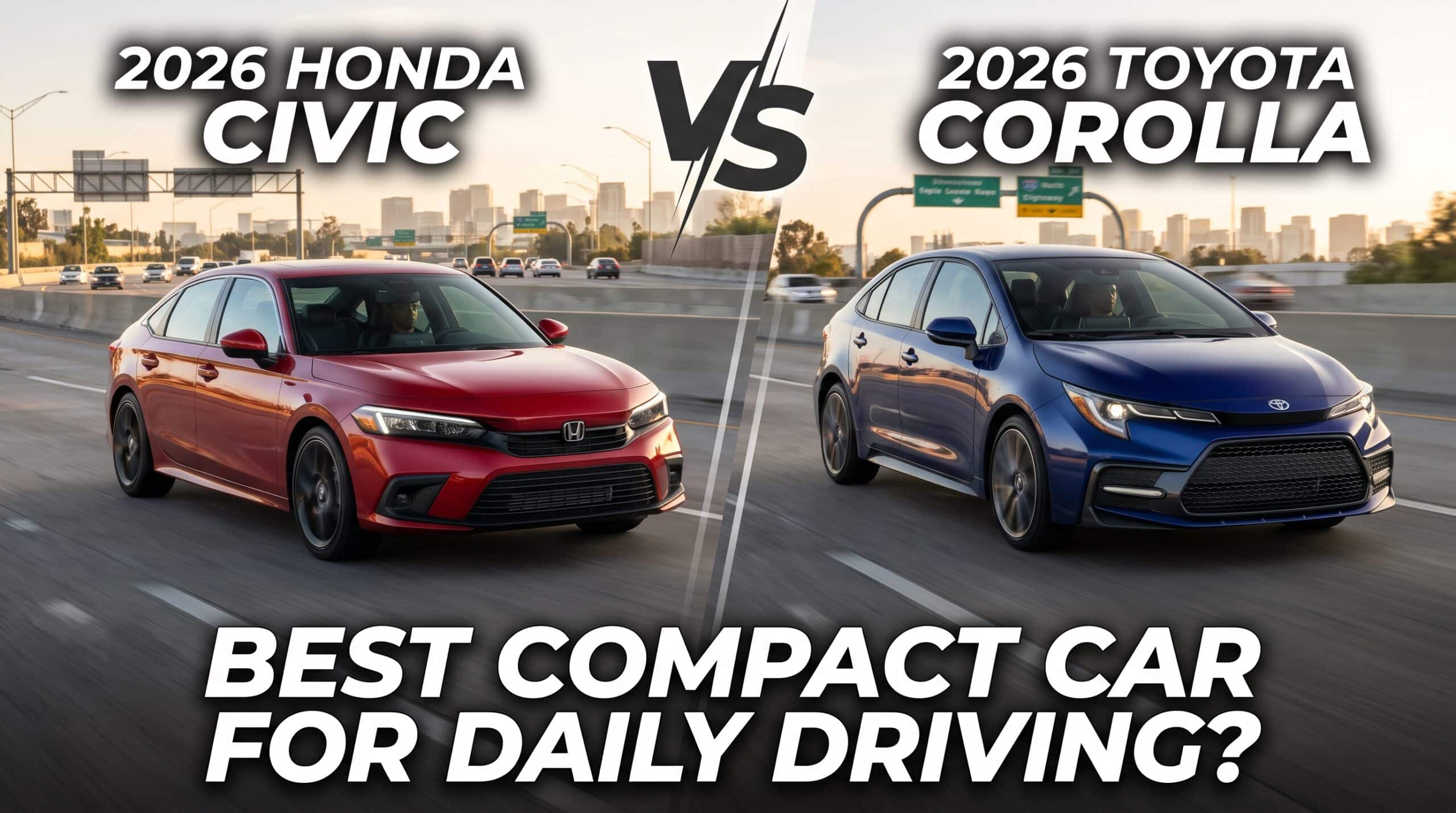
You need a car that starts every morning without drama, sips fuel on the commute, and does not punish your wallet at purchase or over the years. That is the daily-driving reality for most compact sedan shoppers. The 2026 Honda Civic and Toyota Corolla both deliver on those basics, yet they take different paths to get there. One prioritizes driving feel and interior space. The other leans harder into affordability and available all-wheel drive. Choosing between them comes down to which strengths matter most in your routine.
This comparison digs into the details that shape long-term ownership of these two compact sedans. We look at real pricing, fuel efficiency numbers, reliability patterns, cabin practicality, and how each feels on everyday roads. Both cars rank among the strongest options in the class. The right pick depends on whether you value a more engaging drive or the lowest possible cost of entry and operation.
Pricing and Affordability Head-to-Head
The Toyota Corolla starts lower. Base LE models begin around $23,000 to $24,300 before destination and options. The Honda Civic LX typically opens near $24,700 to $25,900. That gap of roughly $1,500 to $2,000 may not seem huge at first, but it compounds when you factor in taxes, fees, and financing.
Higher trims widen or narrow the difference depending on equipment. Corolla Hybrid models remain accessible, with entry hybrid pricing often several thousand dollars below the Civic’s hybrid starting point. The Civic requires stepping up the trim ladder for its strong hybrid powertrain. If pure affordability drives the decision, the Corolla holds a clear edge on the window sticker and on many out-the-door quotes.
Insurance, maintenance, and depreciation also favor both cars, though Toyota’s long-term reputation for holding value often gives the Corolla a slight ownership-cost advantage in multi-year projections. Shoppers focused on minimizing monthly payments and total spend usually find the Corolla easier on the budget.
Powertrains, Performance, and Fuel Efficiency
Both cars use 2.0-liter four-cylinder engines in gas form. The Corolla produces 169 horsepower and 151 lb-ft of torque. The Civic makes 150 horsepower and 133 lb-ft. In real-world driving the Corolla feels a bit more responsive in everyday acceleration and highway merging when both are non-hybrid.
Hybrids flip the script. The Civic Hybrid delivers 200 combined horsepower and strong torque from its two-motor system. It feels noticeably quicker and more confident when you need to pass or climb grades. The Corolla Hybrid makes 138 horsepower. It prioritizes efficiency over urgency and still moves adequately for most commuting.
Fuel economy is excellent on both. Non-hybrid versions sit near 32 city / 41 highway / 35-36 combined mpg. Hybrids push much higher. The Corolla Hybrid can reach 50 mpg combined (and higher city figures in some FWD configurations). The Civic Hybrid lands around 49 mpg combined. Real-world numbers for careful drivers often land in the mid-to-high 40s or better for either hybrid. The Corolla gains an advantage with available all-wheel drive on its hybrid, something the Civic does not offer.
For pure fuel efficiency and the option of AWD in snow or rain, the Corolla Hybrid stands out. For a more energetic hybrid experience that still delivers outstanding mileage, the Civic is hard to beat.
Ride Quality, Handling, and Daily Driving Feel
The Civic has long been the more engaging compact sedan. Its multi-link rear suspension and tighter chassis tuning give it sharper responses in corners and better composure over imperfect pavement. Steering feels more precise. Many drivers simply enjoy the Civic more on a winding road or during a lively commute.
The Corolla prioritizes comfort and predictability. Its ride absorbs bumps competently, and the cabin stays relatively calm at highway speeds. Handling is secure but less eager. Available AWD adds confidence in slippery conditions without changing the car’s fundamentally practical character.
Neither car is sporty in the performance sense, yet the Civic delivers more of that connected, enjoyable sensation that makes daily driving feel less like a chore. The Corolla feels competent and easygoing, which suits drivers who simply want the car to disappear into the background of their routine.
Interior Space, Comfort, and Practicality
Cabin space favors the Civic. It offers more rear legroom and a larger trunk—about 14.8 cubic feet versus the Corolla’s 13.1. The Civic’s seating position and outward visibility also feel more open to many drivers. Materials and fit-and-finish are solid in both, with the Civic often edging ahead in perceived refinement on higher trims.
Both cars seat five adults in a pinch, though the rear seats work best for kids or shorter trips. Storage cubbies, USB ports, and straightforward controls support daily use. Infotainment screens and smartphone integration (wireless Apple CarPlay and Android Auto on many trims) are modern and easy to live with. The Civic’s interior layout tends to feel a bit more upscale and spacious for the money once you move beyond base levels.
Reliability, Ownership Costs, and Long-Term Confidence
Both the Civic and Corolla carry strong reliability reputations. Toyota’s track record with the Corolla nameplate remains one of the best in the industry for high-mileage durability and low unexpected repair costs. Honda’s Civic is similarly well-regarded, with many examples easily exceeding 200,000 miles when maintained properly.
Predicted reliability scores for recent model years place both near the top of the compact class. Annual maintenance costs stay modest. Hybrid systems from both brands have proven durable in real-world use. Warranty coverage is comparable: typically three years/36,000 miles basic and five years/60,000 miles powertrain, with longer hybrid battery coverage on Toyota models.
Resale values are strong for both. The Corolla often holds a slight edge in long-term residual strength, while the Civic benefits from high demand and enthusiast interest in sportier variants. For pure long-term ownership confidence and low ownership friction, either car is an excellent choice. Shoppers who prioritize the absolute lowest lifetime cost frequently lean toward the Corolla.
Safety Features and Everyday Technology
Both models come well-equipped with modern driver-assistance systems. Automatic emergency braking, adaptive cruise control, lane-keeping assist, and blind-spot monitoring appear as standard or widely available features. These systems perform reliably in daily traffic and reduce fatigue on longer highway runs.
Infotainment is user-friendly in both. Higher trims add larger screens, better audio, and more convenience features. Neither car requires a steep learning curve. The technology supports rather than distracts from the primary job of getting you from point A to point B safely and efficiently.
Which Compact Sedan Fits Your Daily Driving Needs?

Choose the Toyota Corolla if affordability, maximum fuel efficiency, and available all-wheel drive sit at the top of your list. It is the lower-priced entry point, offers a highly efficient hybrid at an accessible price, and brings the security of AWD for drivers in snowy or rainy climates. Its reputation for bulletproof reliability and low ownership costs makes it a smart long-term partner.
Choose the Honda Civic if you want a more engaging drive, extra interior and cargo space, and a hybrid that delivers strong performance alongside excellent efficiency. The Civic feels more polished and enjoyable on a daily basis for many drivers, and its hybrid powertrain is one of the strongest in the segment.
Both cars excel at the core compact sedan mission: reliable, efficient, affordable transportation. Test-drive them back-to-back on the roads you actually use. Pay attention to seat comfort, visibility, cabin quietness, and how the powertrains respond in traffic. The numbers tell part of the story. How the car feels after a week of commuting tells the rest.
FAQ
Which is more affordable to buy new in 2026?
The Toyota Corolla starts lower, typically by $1,500 to $2,000 or more depending on trim and region. Hybrid versions of the Corolla are also more accessible than Civic hybrids.
Which gets better fuel economy?
Non-hybrid models are nearly identical. Hybrids favor the Corolla slightly (up to around 50 mpg combined versus the Civic’s 49), and the Corolla offers an AWD hybrid option the Civic lacks.
Is the Civic or Corolla more reliable?
Both rank near the top of the class. Toyota’s Corolla often carries a slight edge in long-term predicted reliability and residual value, while the Civic remains highly dependable with strong owner satisfaction.
Which has more interior space?
The Honda Civic offers more passenger room and a larger trunk (roughly 14.8 cubic feet versus 13.1). It generally feels more spacious for daily use and longer trips.
Should I choose the hybrid version of either car?
Yes for most drivers. Both hybrids deliver outstanding real-world efficiency with minimal compromise. The Civic Hybrid adds stronger performance; the Corolla Hybrid prioritizes maximum mpg and available AWD at a lower entry price.
The 2026 Honda Civic and Toyota Corolla remain two of the smartest compact sedan choices available. One emphasizes driving enjoyment and space. The other maximizes affordability, efficiency, and all-weather capability. Drive both, compare the numbers against your actual commute and budget, and pick the one that disappears into your routine with the least friction. Either way, you will own a compact sedan built for years of dependable daily service.
Leave a Reply