
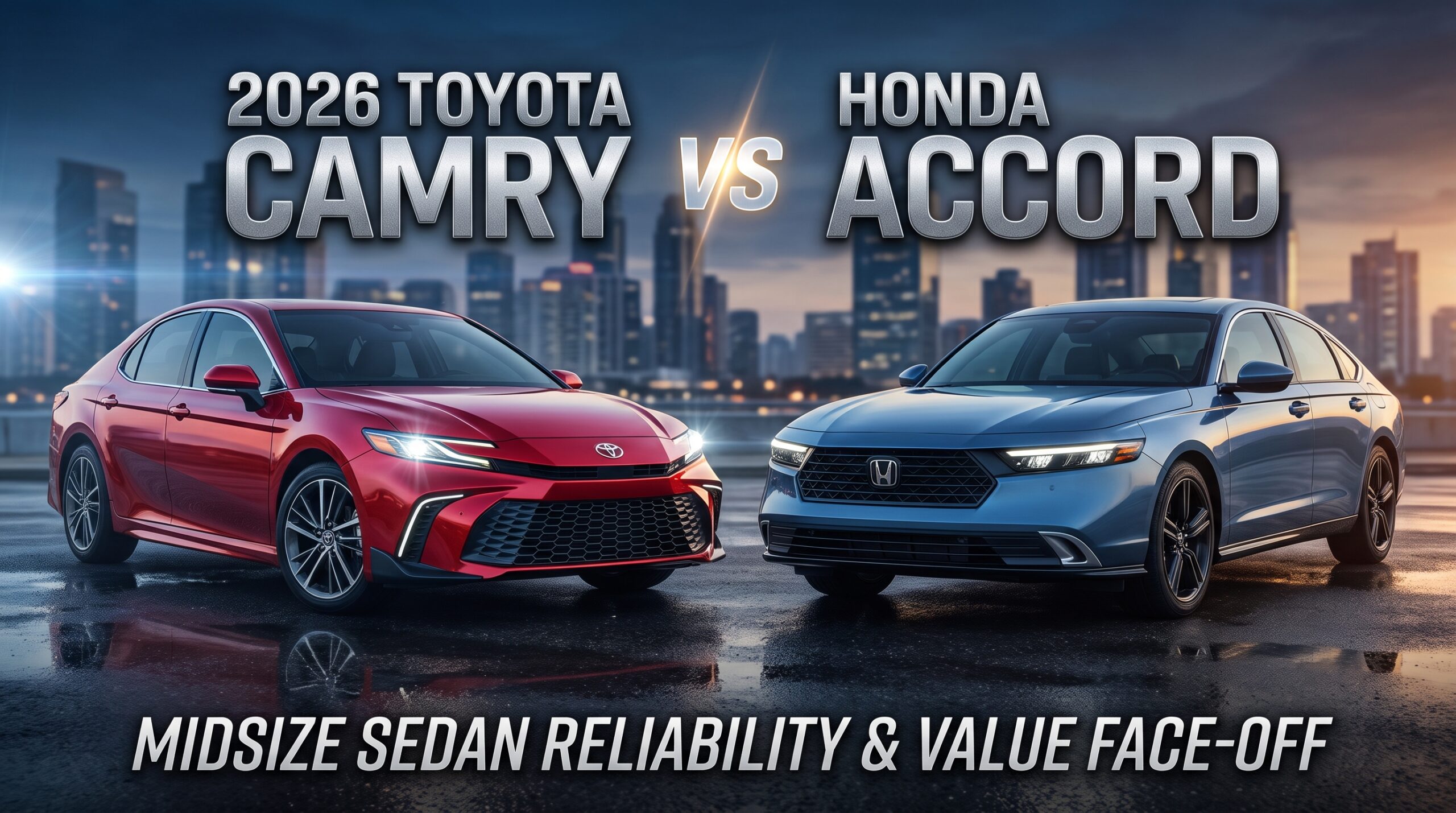
You want a midsize sedan that will still feel solid after 100,000 miles and will not punish you at the pump or the repair shop. Two names dominate that conversation year after year: the Toyota Camry and the Honda Accord. Both carry strong reputations for lasting a long time with relatively low drama. The 2026 versions sharpen the choice.
Toyota made every Camry a hybrid. Honda still offers a pure gasoline option alongside its hybrid. One gives you available all-wheel drive. The other gives you more rear-seat and trunk space. The decision comes down to how you weigh efficiency, space, drivetrain preference, and long-term ownership costs.
This comparison looks at the real differences that matter for reliability and value so you can pick the one that fits your driving and budget.
Powertrains and Everyday Efficiency
The 2026 Camry uses a 2.5-liter four-cylinder hybrid system across every trim. Combined output reaches 225 horsepower with front-wheel drive and 232 horsepower when you add the available all-wheel-drive system. The most efficient LE front-wheel-drive model is rated around 51 to 53 mpg combined, depending on exact testing figures.
The Accord starts with a turbocharged 1.5-liter four-cylinder making 192 horsepower on the LX and SE trims. Higher trims switch to a 2.0-liter hybrid system producing 204 horsepower. The best Accord hybrid ratings sit near 48 mpg combined. The gas models land in the low 30s.
If maximum fuel savings matter most, the Camry pulls ahead. Over 60,000 miles the difference in fuel cost can reach a couple thousand dollars in the Camry’s favor when comparing hybrid to hybrid, and even more against the gas Accord. Both powertrains have proven durable in previous generations, which supports the reliability case for either car.
Pricing and What You Receive at Each Level
The Accord LX gas model usually starts a bit lower, around $28,395 to $29,590 before destination. The Camry LE hybrid begins near $29,000 to $30,195. Once you move into hybrid territory the Camry becomes the clearer value. Every Camry is already a hybrid, while the least expensive Accord hybrid starts several thousand dollars higher.
All-wheel drive is available on every Camry trim for roughly $1,500. The Accord remains front-wheel drive only. For buyers who face snow or simply prefer the extra traction, that difference is decisive. Feature content is competitive on both. Higher trims on each side add larger screens, better materials, and convenience options at similar price points.
Space, Comfort, and Daily Usability
The Accord holds an edge in rear-seat room. Rear legroom measures about 40.8 inches versus the Camry’s 38.0 inches. That extra stretch is noticeable for taller adults or when installing child seats. The Accord’s trunk is also larger at 16.7 cubic feet compared with the Camry’s 15.1 cubic feet.
Both cabins feel well-built and quiet on the highway. Seat comfort is strong in each, though individual preference for firmness and bolstering varies. The Camry’s hybrid system delivers smooth, quiet operation in most conditions. The Accord’s gas engine is refined, and its hybrid is equally polished. Test both with passengers in the back if rear space ranks high on your list.
Reliability and Long-Term Ownership Outlook
Both brands consistently rank near the top of reliability surveys for midsize sedans. Toyota’s hybrid systems have accumulated millions of real-world miles with strong durability records. Honda’s engines and hybrids also earn high marks for longevity when maintained properly.
Resale values remain solid for both. The Camry’s hybrid-only approach and available all-wheel drive may help it hold value especially well in markets that favor efficiency and traction. Maintenance costs stay reasonable on either car when you follow the scheduled service intervals. Independent data on five-year ownership costs often favors the Camry slightly because of lower fuel expense and strong residual values.
A neighbor who has owned both brands over the past decade put it simply: “I stop worrying about the car and just drive it.” That sentiment applies to either of these sedans when they are cared for.
Driving Feel and Real-World Behavior
Neither car aims to be a sports sedan, yet both feel composed and confidence-inspiring. The Camry’s hybrid delivers strong low-speed response and relaxed highway manners. Available all-wheel drive adds peace of mind in wet or snowy conditions without major compromises in dry-road behavior.
The Accord is often praised for a slightly more engaging chassis and precise steering. The gas models feel lively enough for daily driving, and the hybrid versions add instant torque that makes merging easy. Ride quality is comfortable on both, with the Accord sometimes noted for a touch more compliance over broken pavement.
Your preference will likely come down to whether you prioritize the Camry’s efficiency and optional AWD or the Accord’s extra space and driving polish.
Which Buyer Should Choose Which Car

Choose the 2026 Toyota Camry if you want maximum fuel economy, hybrid power on every trim, and the option of all-wheel drive. It is the stronger pick for high-mileage drivers and anyone focused on the lowest long-term running costs.
Choose the 2026 Honda Accord if rear-seat and trunk space matter more, you prefer the option of a pure gasoline engine at a lower entry price, or you simply like the way the Accord drives and feels inside. It remains an excellent long-term ownership choice with its own strong reliability record.
Both will serve you well for years. The Camry currently holds advantages in efficiency and drivetrain flexibility. The Accord counters with space and a slightly lower starting price on the gas models.
FAQ
1. Which is more fuel-efficient?
The Toyota Camry. Its LE hybrid reaches around 51 mpg combined, while the best Accord hybrid sits near 48 mpg and the gas models are in the low 30s.
2. Does either offer all-wheel drive?
Only the Camry. AWD is available on every trim. The Accord remains front-wheel drive only.
3. Which has more interior and trunk space?
The Honda Accord. It offers more rear legroom and a larger trunk.
4. Which costs less to own over five years?
The Camry often edges ahead thanks to superior fuel economy and strong resale, especially when comparing hybrid models.
5. Are both reliable long-term choices?
Yes. Both brands have excellent track records in the midsize sedan segment for durability and lower-than-average repair frequency when maintained properly.
The 2026 Toyota Camry and Honda Accord continue the long rivalry that has defined the midsize sedan class. The Camry’s full hybrid lineup, high efficiency numbers, and available all-wheel drive make it the value leader for many buyers focused on long-term ownership costs. The Accord answers with more passenger and cargo space, a lower gas-model entry price, and its own proven reliability.
Decide what you will use most—maximum mpg and optional AWD, or extra rear room and trunk capacity—then drive both on the same route. Sit in the back seat. Load the trunk. Check current local pricing and inventory. The right midsize sedan for your needs will become clear once you experience the differences in person. When you are ready, compare offers and choose the one that best balances reliability, efficiency, and daily practicality for the years ahead.
Leave a Reply