
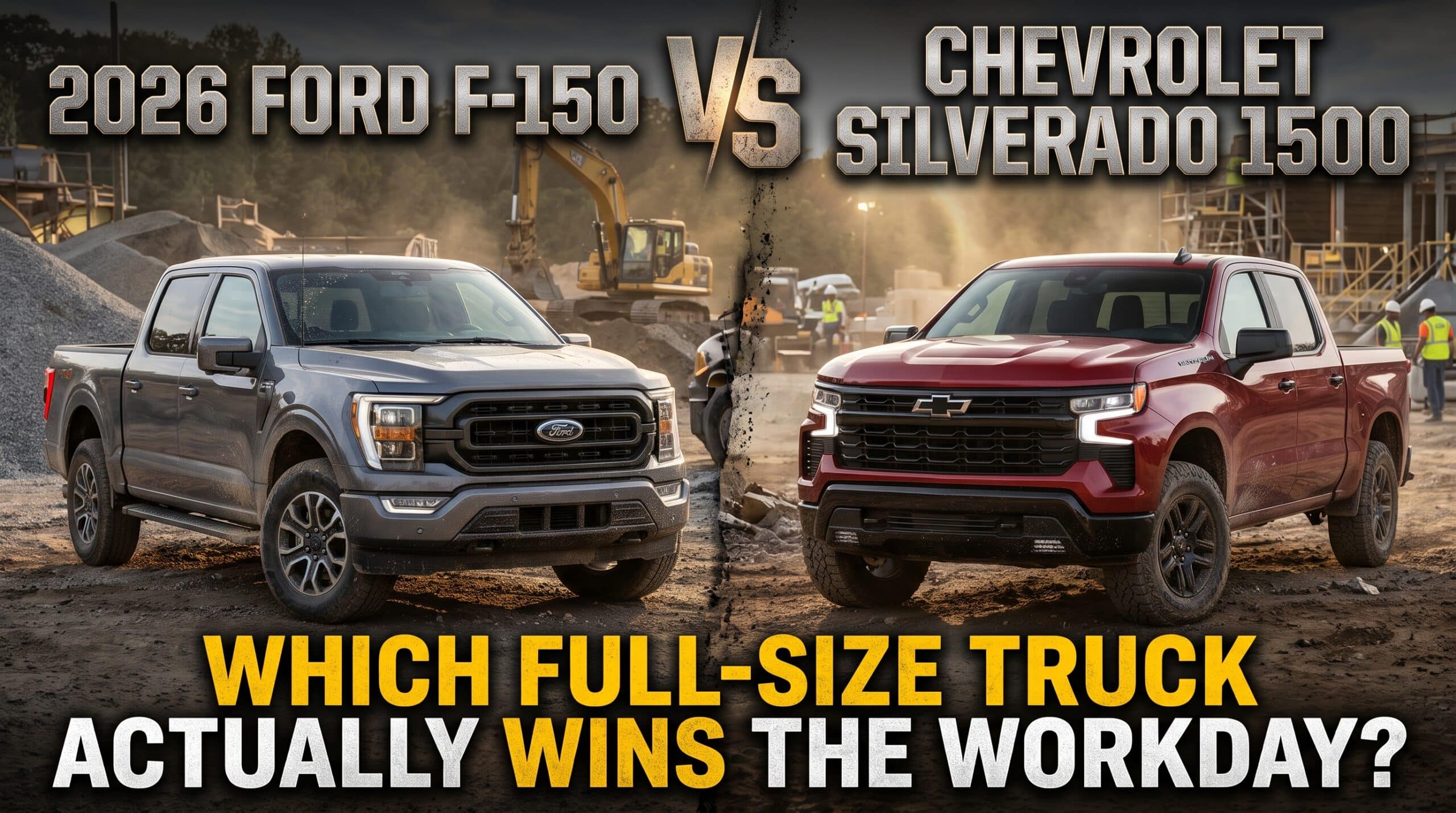
You need a truck that tows the trailer, hauls the tools, and still feels decent on the daily commute. The two names that keep coming up are the Ford F-150 and the Chevrolet Silverado 1500. Both claim big numbers. Both look capable on the lot. The real differences only show up when you dig into towing ratings, payload figures, powertrain choices, and how each truck behaves when the bed is loaded or the trailer is hooked up.
This truck comparison cuts through the brochure language. We look at what the 2026 versions actually deliver for work capability, fuel use, cabin practicality, and long-term ownership so you can match the right pickup to your real needs.
Powertrain Lineups and Real-World Pulling Power
Ford gives you more engine choices. The base 2.7-liter EcoBoost V6 makes 325 horsepower and 400 lb-ft of torque. Step up and you find the 5.0-liter V8, the strong 3.5-liter EcoBoost, and the PowerBoost full hybrid that combines the 3.5-liter with electric assist for a combined 420 horsepower and 570 lb-ft. High-output and Raptor versions push the performance ceiling even higher.
Chevrolet keeps the menu simpler but still useful. The standard 2.7-liter TurboMax four-cylinder delivers 310 horsepower and a healthy 430 lb-ft of torque. Above that sit the 5.3-liter and 6.2-liter V8s, plus the 3.0-liter Duramax diesel that produces 305 horsepower and 495 lb-ft. That diesel is the Silverado’s clearest unique card. Ford has no diesel in the regular half-ton F-150.
In everyday driving the Ford hybrid feels strongest off the line and smoothest in traffic. The Chevy diesel pulls with less drama once the trailer weight climbs and returns better highway numbers on long hauls. The gas V8s in both trucks remain the most straightforward choice for drivers who want simple, proven power without hybrid complexity or diesel maintenance considerations.
Towing Capacity: Where the Numbers Matter Most
Properly equipped, the 2026 F-150 reaches 13,500 pounds of maximum conventional towing. That figure usually requires the 3.5-liter EcoBoost, the right axle, the Tow/Haul package, and a specific cab-and-bed combination. The Silverado tops out at 13,300 pounds, most often with the Duramax diesel or a high-spec 6.2-liter V8 and the Max Trailering Package.
The 200-pound gap looks small on paper. In practice both trucks handle the majority of recreational trailers and work equipment with room to spare. What separates them is how the capability is delivered. Ford’s Pro Trailer Backup Assist and hitch-assist features make connecting and maneuvering easier for many drivers. Chevrolet counters with strong camera views and solid integrated trailer-brake control.
If you regularly tow near the upper limits, configure either truck carefully and verify the door-jamb sticker on the exact vehicle you plan to buy. Brochure maximums almost never apply to the loaded crew-cab four-wheel-drive models most people actually drive.
Payload and Bed Utility for Daily Work
Payload tells you how much weight you can put in the bed and cabin before the truck is overloaded. The F-150 leads with a maximum of 2,440 pounds in the lightest configurations. The Silverado’s best published figure sits around 2,260 pounds. Again, real-world numbers drop once you add four-wheel drive, a crew cab, heavier options, or passengers.
Chevrolet offers a slight edge in maximum bed volume on the longest box, reaching roughly 89 cubic feet versus Ford’s 77-plus. More tie-down points on some Silverado beds also help secure irregular loads. Ford answers with clever tailgate options, available work surfaces, and the Pro Power Onboard system that turns the hybrid into a mobile generator capable of running tools or even limited home backup power.
For pure cargo volume the Silverado can feel roomier. For mixed work that includes power tools and job-site electricity, the F-150 hybrid changes the equation.
Cabin Comfort, Technology, and Daily Driveability
Both trucks offer spacious crew-cab rear seats that adults can use without complaint. Ford’s interior tends to feel more refined in mid and upper trims, with a standard 12-inch touchscreen across more of the lineup and thoughtful storage solutions. Chevrolet’s larger 13.4-inch screen on higher trims looks impressive, yet base models still ship with a smaller display.
Ride quality depends heavily on suspension and tire choice. Many drivers find the Silverado a bit more composed on broken pavement in standard configurations. The F-150 feels planted when loaded and offers a wider range of adaptive and off-road suspensions. BlueCruise hands-free highway driving is available on more F-150 trims than Super Cruise is on the Silverado, giving Ford an edge for long interstate miles.
Noise levels, seat support, and control layout come down to personal preference. Spend time in both. The truck that feels right after an hour on mixed roads is usually the better long-term partner.
Fuel Economy and Ownership Costs
On paper the PowerBoost hybrid and the Duramax diesel deliver the best efficiency numbers in this pairing. Real-world results depend on how you drive and what you haul. The hybrid shines in stop-and-go and mixed use. The diesel stretches farther on steady highway runs with a trailer behind it.
Base gas engines favor the F-150 slightly on highway ratings in many comparisons. Maintenance patterns differ too. The hybrid adds battery and electric-motor considerations over time. The diesel requires attention to emissions equipment and fuel quality. Traditional gas V8s remain the lowest-drama choice for many owners who simply want predictable service costs.
Resale strength has historically favored the F-150, though strong demand for both trucks keeps values competitive when the vehicles are well maintained and properly optioned.
Which Truck Fits Your Actual Work
Choose the F-150 if maximum payload, the hybrid powertrain with onboard generator capability, wider availability of hands-free driving, or the highest published towing figure matter most. It also suits buyers who want more engine variety and strong trailer-assist technology.
Choose the Silverado if you want the diesel’s torque and highway efficiency, prefer a slightly lower starting price in base form, value maximum bed volume, or simply prefer the way the Chevy drives and feels. Its traditional truck character still resonates with many commercial and recreational users.
Neither truck is universally better. The right answer depends on the weight you actually move, the distances you cover, and whether you value hybrid versatility or diesel range more highly. Configure both with the cab, bed, axle, and packages that match your trailer or cargo, then drive them back-to-back with similar loads if possible.
Look past the headline numbers. Check the specific payload sticker, confirm the towing package is present, and decide which powertrain philosophy fits the way you work. That process leads to a truck that stays useful for years instead of one that merely looked good on the lot.
FAQ
Which 2026 truck tows more, the F-150 or the Silverado 1500?
The F-150 reaches a maximum of 13,500 pounds when properly equipped. The Silverado tops out at 13,300 pounds. In most real-world crew-cab configurations the difference shrinks and both remain highly capable.
Does the F-150 or Silverado have higher payload capacity?
The F-150 leads with a maximum published payload of 2,440 pounds. The Silverado’s best figure is approximately 2,260 pounds. Actual capacity on any given truck is lower once options and four-wheel drive are added.
Is there a diesel option in the 2026 F-150?
No. The regular half-ton F-150 does not offer a diesel. The Silverado 1500 continues to offer the 3.0-liter Duramax turbo-diesel.
Which truck is better for work sites that need electrical power?
The F-150 PowerBoost hybrid with Pro Power Onboard can supply up to 7.2 kW of exportable power. That capability has no direct equivalent in the Silverado 1500.
Should I buy based on maximum towing numbers alone?
No. Most owners never approach the brochure maximums. Focus on the rating of the exact cab, bed, engine, and axle combination you will drive, then factor in payload, fuel type, and daily comfort.
Test both trucks the way you will use them. Load the beds. Hook up a representative trailer if you can. The one that feels more capable and more comfortable under those conditions is the one worth buying.
Leave a Reply