
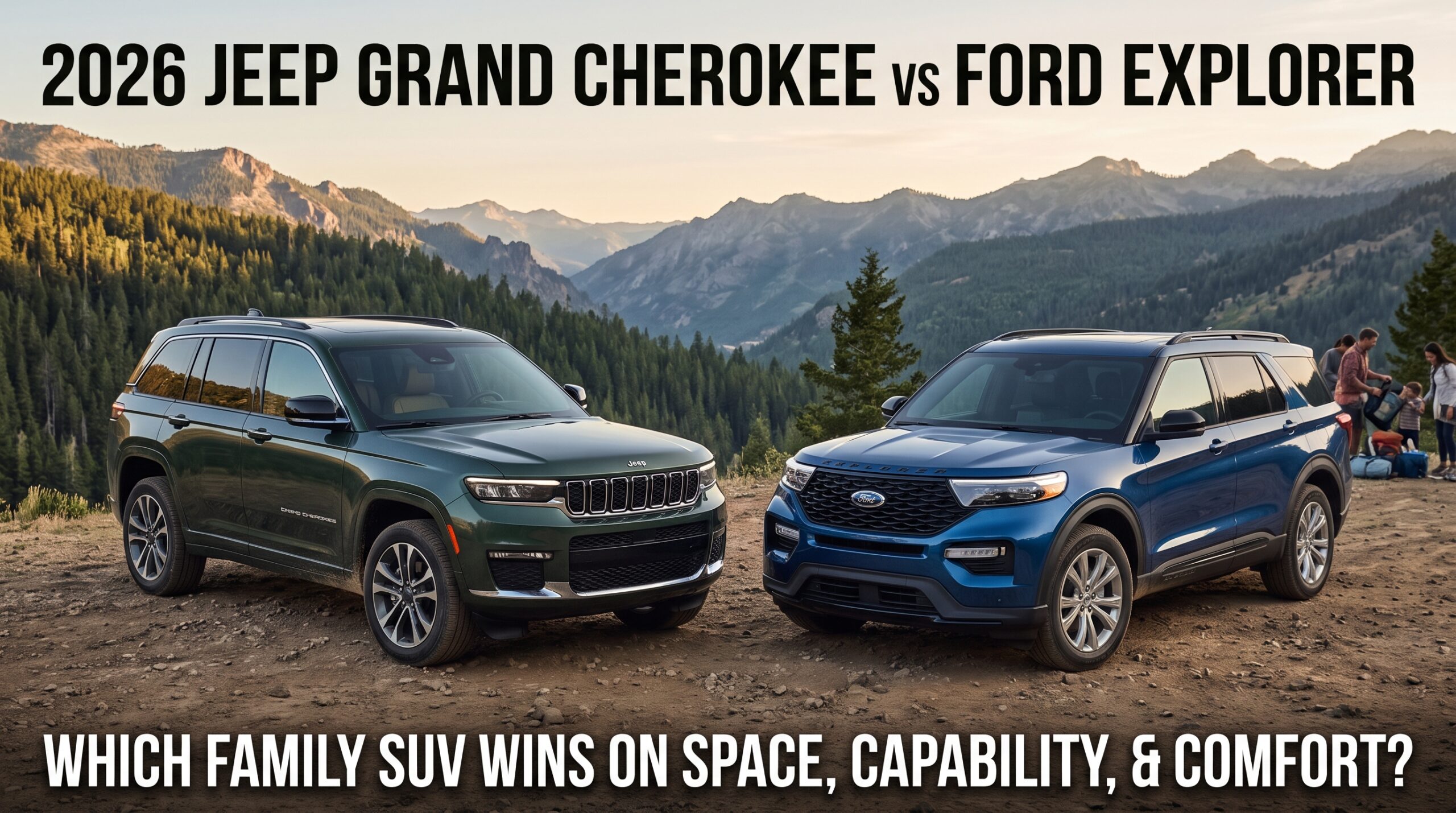
You need a midsize SUV that swallows kids, gear, and weekend plans without complaint. The third row has to be usable. Towing a small boat or trailer should not feel like a gamble. And the cabin must stay quiet and comfortable after hours on the highway. Two nameplates keep rising to the top of that list: the 2026 Jeep Grand Cherokee and the 2026 Ford Explorer. Both start near $39,000–$41,000. Both claim family-hauler credentials. Yet they solve the problem in different ways.
One leans harder into off-road ability and premium cabin feel. The other prioritizes standard three-row packaging and stronger on-road manners for most buyers. This comparison walks through the real differences in space, capability, comfort, power, and ownership so you can match the right SUV to your actual life.
Pricing and Trim Strategy for Family Buyers
The 2026 Grand Cherokee opens around $38,920 to $41,000 for a Laredo two-row model. The longer Grand Cherokee L three-row versions start a few thousand higher. Higher trims climb quickly into the high $50,000s and beyond once you add the Hurricane engine, air suspension, and luxury packages.
The Explorer undercuts slightly at the base, starting near $38,465 to $40,260 for an Active. Most family shoppers land in the mid-$40,000s for well-equipped versions. The ST and new Tremor trims push higher, especially with the twin-turbo V6.
Both brands offer frequent incentives. The real cost difference often comes down to how many options you actually need. Families who want three rows without stretching the budget usually find the Explorer easier to configure. Those chasing specific capability packages may spend more on the Jeep and feel the difference every time the pavement ends.
Passenger Space and Cargo Reality
The Explorer comes standard with three rows. Second-row captain’s chairs or a bench are available, and the third row works for kids or shorter adults on moderate trips. Maximum cargo volume reaches roughly 85 cubic feet with all seats folded. Behind the third row you still get usable space for grocery runs.
The standard Grand Cherokee is a two-row SUV with strong second-row legroom and about 37.7 cubic feet of cargo behind the rear seats, expanding to around 70.8 cubic feet when folded. The Grand Cherokee L stretches the wheelbase and adds a third row that competes more directly with the Explorer. Even then, the Explorer often feels roomier for full-family loads.
If your household regularly needs seven seats, the Explorer starts with the right foundation. If five seats and maximum cargo flexibility matter more most days, the two-row Grand Cherokee stays competitive and easier to park.
Capability: Towing, Ground Clearance, and Off-Road Tools
Jeep owns this category for most buyers who leave the pavement. Properly equipped Grand Cherokees tow up to 6,200 pounds. Available Quadra-Lift air suspension delivers class-leading ground clearance. Select-Terrain modes, available low-range gearing on certain systems, and Trailhawk hardware give the Jeep a genuine edge when the road turns to dirt, snow, or rutted trails.
The Explorer tows up to about 5,000–5,600 pounds depending on configuration. That covers many boats, small campers, and utility trailers. The new Tremor trim adds extra ground clearance, all-terrain tires, skid plates, and a limited-slip differential for light off-road work. It is more capable than previous Explorers, yet it still trails the Jeep’s hardware depth.
For pure family capability that includes occasional trail use or higher towing needs, the Grand Cherokee delivers more confidence. For mostly paved roads with light towing, the Explorer is more than enough.
Comfort, Ride Quality, and Cabin Feel
Higher-trim Grand Cherokees feel more luxurious. Materials, seat comfort, and noise isolation often edge ahead, especially with available air suspension that smooths broken pavement. The Uconnect system with its larger standard screen is responsive, and available passenger displays add convenience.
The Explorer improved its cabin significantly in recent years. The 13.2-inch touchscreen and digital cluster look modern. BlueCruise hands-free highway assist reduces fatigue on long trips. Ride quality is composed on pavement, and the available V6 delivers strong, refined power. Some budget plastics remain, but daily comfort for most families is excellent.
Seat both vehicles with your actual family. Check third-row access, child-seat installation, and how the cargo area swallows strollers or sports gear. Comfort is personal, and the test drive reveals more than any specification sheet.
Powertrains and Everyday Driving
The Grand Cherokee’s new 2.0-liter Hurricane turbo four makes 324 horsepower and 332 lb-ft of torque. It feels stronger than the numbers suggest and improves efficiency over the older V6 in many situations. The 3.6-liter V6 remains available on lower trims.
The Explorer’s standard 2.3-liter EcoBoost four produces 300 horsepower and strong low-end torque. The optional 3.0-liter twin-turbo V6 jumps to 400 horsepower and turns the ST into a genuine performer. The 10-speed automatic is smooth in both engines.
On the highway the Explorer often feels more eager and efficient. Around town and when loaded, both move with authority. Fuel economy favors the Explorer in most comparable configurations, which adds up over years of family driving.
Technology, Safety, and Ownership Considerations
Both offer modern driver-assistance suites. The Explorer’s available BlueCruise stands out for long highway stretches. The Grand Cherokee counters with strong standard safety features and available advanced systems. Check current IIHS and NHTSA ratings for the exact configuration you want.
Warranty coverage is similar at the basic level. Real-world reliability and repair costs vary by powertrain and owner reports. Factor in insurance quotes for the specific trims you are considering. Residuals have been competitive for both, though market conditions shift.
Service networks are widespread. Jeep’s off-road focus and Ford’s volume give both strong dealer support in most regions.
Who Should Buy Which Family SUV

Choose the 2026 Jeep Grand Cherokee if capability, towing strength, and a more premium two-row (or L three-row) experience matter most. It rewards drivers who occasionally leave the pavement or haul heavier trailers.
Choose the 2026 Ford Explorer if standard three-row space, strong on-road manners, available high-power V6, and hands-free highway tech top your list. It is the more complete everyday family hauler for most households.
Sit in both with car seats installed. Load the cargo areas. Drive the same route with your typical passengers. The right answer becomes obvious once the vehicles are no longer abstract numbers on a screen.
Both the Grand Cherokee and Explorer remain among the strongest midsize family SUV choices available. Match the strengths to your actual needs and you will end up with a vehicle that makes daily life easier rather than more complicated.
FAQ
Which has more passenger space for a family of five or six?
The Ford Explorer offers standard three-row seating and generally more flexible cargo volume behind the third row. The Grand Cherokee L closes the gap, but the base Grand Cherokee is two-row only.
Which tows more, the 2026 Grand Cherokee or Explorer?
The Grand Cherokee is rated up to 6,200 pounds when properly equipped. The Explorer tops out lower, typically around 5,000 to 5,600 pounds.
Is the Grand Cherokee more capable off-road?
Yes. Available air suspension, higher ground clearance options, and more sophisticated 4×4 systems give the Jeep a clear advantage for serious trail use. The Explorer Tremor improves light-duty capability but does not match the Jeep’s hardware depth.
Which is more comfortable on long highway trips?
Both ride well. Higher-trim Grand Cherokees often feel quieter and more refined. The Explorer’s available BlueCruise reduces driver fatigue on mapped highways. Personal preference and specific trim level decide this one.
Which is better value for most families?
The Explorer frequently delivers more usable space and features for the money when three rows are required. The Grand Cherokee justifies its price with capability and cabin quality that many buyers value highly. Calculate with your real needs rather than base prices alone.
Leave a Reply