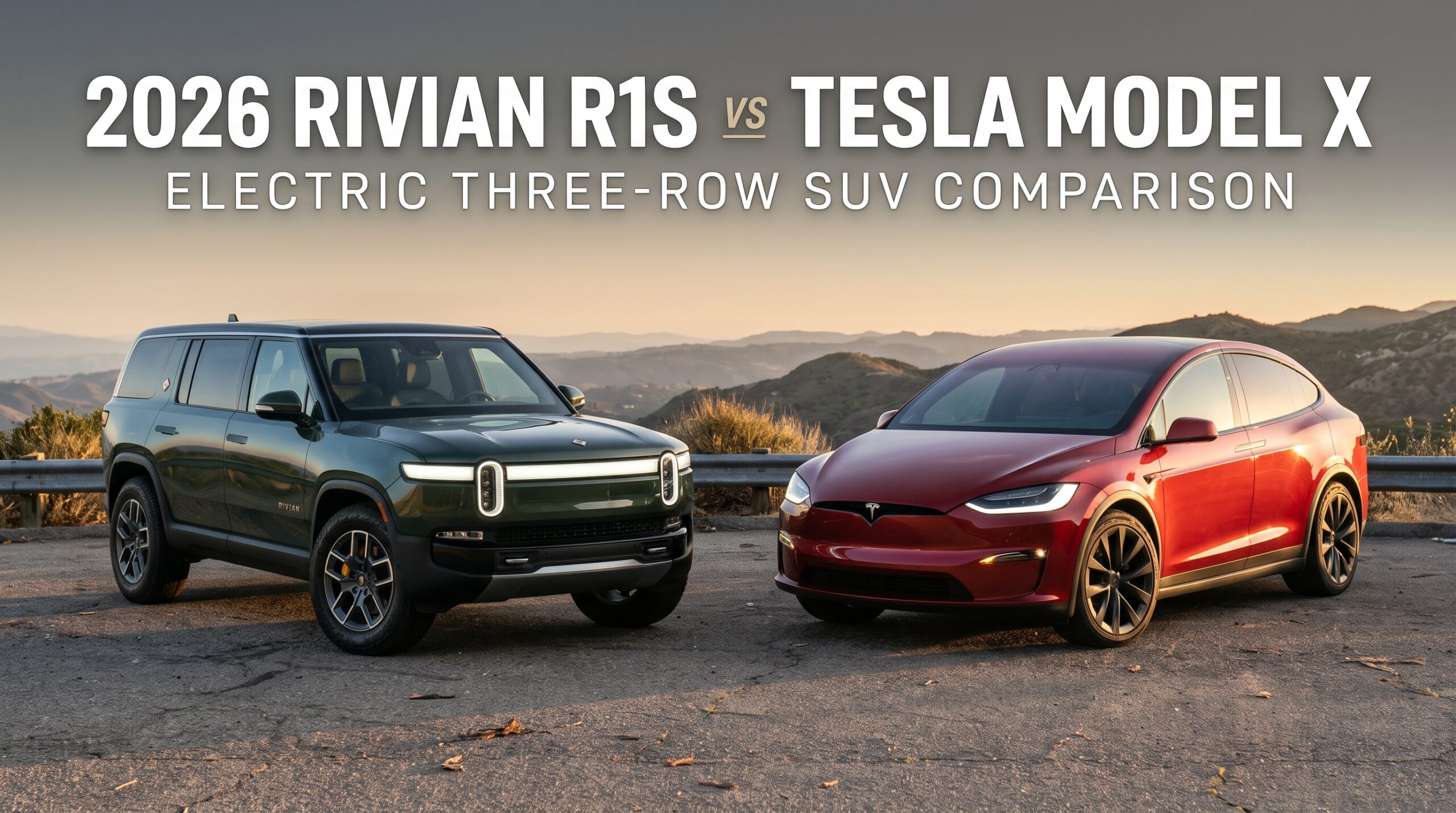
You want a three-row electric SUV that can haul the family, cover serious distance on a charge, and still feel special every time you climb in. The problem is that the two strongest contenders pull in opposite directions. One is built for adventure and real-world versatility. The other prioritizes polished luxury, instant acceleration, and the densest charging network in the country. That tension defines the 2026 Rivian R1S versus Tesla Model X decision.
Both deliver strong range, rapid performance, and modern electric-SUV packaging. Yet they solve the daily and weekend needs of owners in noticeably different ways. This comparison breaks down range, interior space, capability, driving character, and ownership realities so you can match the right electric SUV to how you actually live.
Range, Efficiency, and Charging Reality
Range sits at the center of any electric SUV conversation. The 2026 Rivian R1S Dual with the Max battery pack reaches an EPA-estimated 410 miles in ideal conditions. Large-pack Dual models land around 329 miles, while Tri and Quad Max configurations sit in the 370-mile range. Real-world highway numbers typically fall 10-15 percent lower, and cold weather takes a bigger bite.
The Tesla Model X posts up to 352 miles on the dual-motor version and roughly 335 miles on the Plaid. Tesla’s efficiency numbers often look stronger on paper in mixed driving, and many owners report consistent highway results near the EPA figures when temperatures cooperate.
Charging experience diverges sharply. Tesla still owns the most reliable and widespread fast-charging network in North America. Plug in, walk away, and the session usually just works. Rivian has expanded its own network and supports NACS, yet long trips still require more planning around third-party stations. Both cars accept high-power DC charging and can add substantial range in 20-30 minutes under good conditions. Home charging overnight remains the practical daily solution for either vehicle.
If your driving mixes long highway stretches with occasional remote travel, the Rivian’s higher ceiling and adventure-oriented packaging can feel more reassuring. Pure urban and suburban highway users often prefer the Model X’s network advantage and refined efficiency.
Performance and Driving Character
Both SUVs deliver the kind of effortless acceleration that still surprises people new to high-power electrics. The Rivian Dual Motor starts at 533 horsepower. Step up to the Tri or Quad and output climbs to 850 or 1,025 horsepower, with 0-60 times dropping into the mid-2-second range on the quickest versions. Torque arrives instantly and the air suspension keeps the big body composed.
The Model X dual-motor version makes around 670 horsepower and reaches 60 mph in under four seconds. The Plaid version jumps past 1,000 horsepower and posts 0-60 times as low as 2.5 seconds. On smooth pavement the Tesla feels slightly more refined and planted at high speed. The Falcon Wing doors and lower stance contribute to a more car-like sensation.
Ride quality follows the same split. The Rivian’s adjustable air suspension soaks up rough pavement and can raise ground clearance for trails. It feels purposeful and capable. The Model X prioritizes a quieter, more isolated highway experience. Neither is harsh, yet the character difference is clear after a few miles.
Interior Space, Seating, and Everyday Usability
Both vehicles offer three-row seating. The Rivian R1S comes standard with seven seats and a more upright, boxy cabin that maximizes headroom and third-row usability. Cargo space behind the third row measures about 17.6 cubic feet, expanding dramatically when the rear seats fold. The frunk adds useful extra storage, and the overall layout favors gear, dogs, and family road trips.
The Model X can be configured for five, six, or seven seats. Its third row is usable for kids or shorter adults, though adults find the Rivian more accommodating on longer journeys. Cargo volume behind the third row is tighter in the Model X when configured for seven, but the five-seat layout opens up substantial space. The signature Falcon Wing doors remain a party trick that simplifies loading in tight parking spots once you learn their clearance requirements.
Material quality and tech presentation differ. Rivian’s cabin has improved with the Gen 2 updates, offering a clean, modern adventure-luxury feel with durable surfaces and a large central screen. Tesla’s minimalist approach still leads in software polish and over-the-air feature delivery. Both support multiple wireless phone chargers, strong audio systems, and comprehensive driver-assistance suites.
Adventure Capability Versus On-Road Luxury
This is the clearest philosophical divide. The Rivian R1S was engineered for more than pavement. Ground clearance can reach nearly 15 inches with the air suspension raised. Approach, breakover, and departure angles support genuine trail use. Towing capacity hits 7,700 pounds. Off-road drive modes, underbody protection, and a rugged aesthetic complete the package. Owners who camp, tow boats, or explore unpaved roads find the R1S uniquely capable among three-row electrics.
The Model X stays firmly in the luxury electric SUV lane. Its strength is quiet, rapid highway travel, advanced driver assistance, and the convenience of the Supercharger network. Ground clearance and off-road angles are modest. Towing is limited to 5,000 pounds. It excels as a refined daily driver and long-distance cruiser rather than an adventure vehicle.
If your ideal weekend includes dirt roads, trailheads, or hauling outdoor equipment, the Rivian answers the call. If your priorities center on seamless highway travel, cutting-edge software, and a more car-like luxury experience, the Model X remains compelling.
Pricing, Value, and Ownership Considerations
The Rivian R1S Dual Motor starts in the high $70,000s to low $80,000s depending on battery pack. Higher-output Tri and Quad models climb into six figures. The Model X typically starts higher, often near or above $100,000 for remaining new inventory or recent configurations, with Plaid versions priced further up.
Both vehicles carry strong residual value for electric SUVs, though market conditions and production status can shift the used landscape quickly. Insurance costs run higher than mainstream three-row SUVs because of repair complexity and performance. Maintenance is minimal compared with gasoline counterparts—primarily tires, brakes, and cabin filters—yet specialized service networks matter. Tesla’s larger footprint still offers more service locations in many regions.
Software updates continue to improve both vehicles after purchase. Rivian has made notable strides in refinement and feature delivery. Tesla’s update cadence remains one of the most aggressive in the industry.
Which Electric Three-Row SUV Fits Your Life?
Choose the Rivian R1S if adventure capability, maximum range options, standard seven-seat practicality, and stronger towing matter most. It feels purpose-built for owners who want an electric SUV that can leave the pavement without hesitation while still serving as a comfortable daily driver.
Choose the Tesla Model X if you prioritize the Supercharger network, refined on-road manners, rapid software evolution, and a more luxurious, tech-forward cabin experience. It remains one of the most capable highway-focused electric SUVs available.
Test both if possible. Pay attention to third-row access, cargo loading with seats up, how the suspension feels on your local roads, and how the charging experience fits your typical trips. The numbers on range and horsepower only tell part of the story. How the vehicle integrates into your actual weekends and weekday routines decides the winner.
FAQ
Which has better range in 2026?
The Rivian R1S Dual with the Max battery pack leads with an EPA estimate up to 410 miles. The Model X tops out around 352 miles. Real-world results depend heavily on speed, temperature, and load.
Is the Rivian R1S better for off-roading?
Yes. Higher ground clearance, better approach and departure angles, dedicated off-road modes, and higher towing capacity give the R1S a clear advantage for unpaved or adventurous use.
Which is more practical for a family of five or six?
Both work well. The Rivian’s standard seven-seat layout and more generous third-row space often feel more family-friendly for regular use. The Model X offers flexible configurations and unique Falcon Wing door access.
How do charging networks compare?
Tesla’s Supercharger network remains the most convenient and widespread. Rivian has expanded its own stations and supports NACS, yet long-distance travel still benefits from more careful route planning.
Which offers better value?
The Rivian typically starts at a lower price for comparable range and capability. The Model X commands a premium for its network, software, and on-road refinement. Value depends on which strengths you will actually use.
The 2026 Rivian R1S and Tesla Model X represent two distinct visions of the electric three-row SUV. One invites you to explore farther and tackle rougher roads. The other delivers a smoother, more connected luxury experience backed by the strongest charging infrastructure available. Drive them, compare the ownership realities that matter to your household, and choose the electric SUV that matches the life you actually lead.
Leave a Reply