
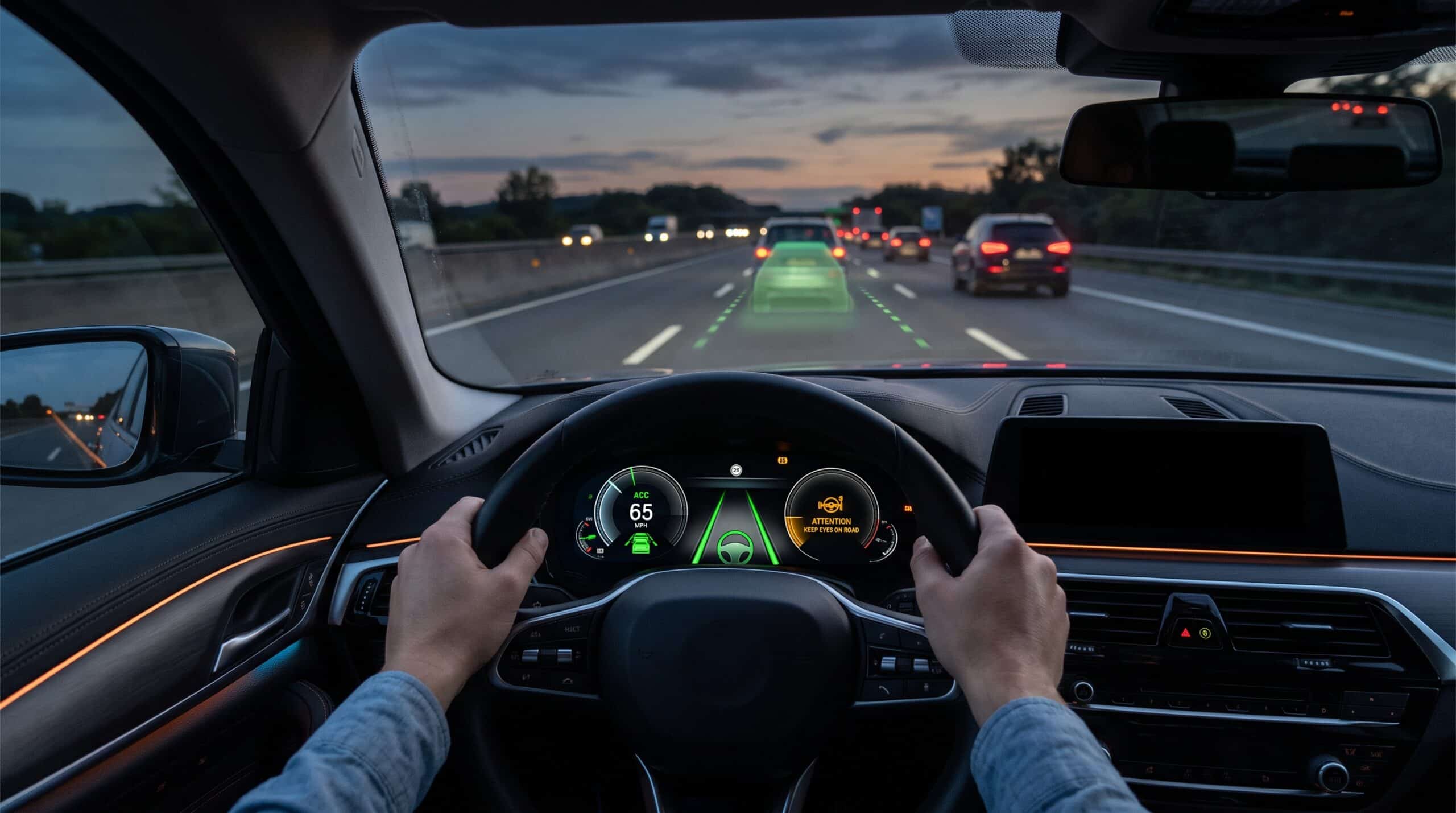
That moment is becoming everyday life for millions of drivers. Modern cars pack layers of car safety features that intervene faster than most humans can react. Yet many of us treat them like mysterious black boxes. We either ignore the warnings or lean on them too hard. Neither approach works. Understanding the key automotive safety technologies available in 2026 changes how you drive, how you shop for a car, and how you stay alive on the road.
This guide walks through the most important advanced driver assistance systems right now. We will cover what they do, how they fail, and the practical habits that make them genuinely useful. No marketing fluff. Just the details that matter when you are behind the wheel.
What ADAS Really Means in 2026 and Why the Levels Still Matter
Advanced driver assistance systems, or ADAS, are not self-driving cars. They assist. You remain responsible. The SAE levels still shape everything you see in showrooms and on the road.
Level 0 and Level 1 cover basic warnings and single-function support like adaptive cruise or lane-keeping that needs constant input from you. Level 2 combines steering and speed control under your supervision. Most systems sold in 2026 sit here or in the expanded L2+ category that allows hands-free driving on mapped highways while still requiring your eyes on the road and readiness to take over.
True Level 3 systems, where the car can handle the driving task in limited conditions and you can look away, remain rare and tightly restricted. Several manufacturers pulled or delayed broader Level 3 rollouts because of liability, cost, and real-world edge cases. The practical focus for 2026 is stronger, more reliable L2 and L2+ systems that work more often and with better driver monitoring.
When you sit in a new vehicle, ask the salesperson exactly which level the system reaches and under what conditions. The answer tells you far more than a glossy brochure.
Automatic Emergency Braking and Forward Collision Systems That Stop Crashes Before They Start
Automatic emergency braking sits at the top of any list of essential car safety features. The system uses cameras and radar to watch the road ahead. If it detects a vehicle, pedestrian, or sometimes a cyclist and you do not react, it applies the brakes hard.
NHTSA has made clear that AEB will become mandatory on new light vehicles by 2029. Many 2026 models already exceed the coming standard. Pedestrian detection works in daylight and, on better systems, at night. Some versions slow or stop the car from highway speeds in certain scenarios.
I once rode with a colleague who trusted the system completely. Traffic stopped suddenly on a rain-slicked freeway. The AEB kicked in and shortened the stopping distance enough that we avoided a rear-end collision by a few feet. He still felt the jolt. The technology bought time; it did not erase physics.
Forward collision warning usually activates first with a visual or audible alert. Treat that warning as your cue to brake or steer. Do not wait for the automatic intervention. Systems vary widely in performance. Some work better in clear weather; others struggle with heavy rain, fog, or dirty sensors. Keep the front camera and radar clean. A muddy grille can disable the very feature designed to protect you.
Lane Keeping, Lane Centering, and Blind-Spot Intervention
Lane departure warning beeps when you drift without signaling. Lane-keeping assist adds gentle steering torque to nudge you back. Lane-centering systems go further and actively hold the vehicle near the middle of the lane on well-marked roads.
Blind-spot monitoring lights up the side mirror when another vehicle sits in the danger zone. Blind-spot intervention takes the next step. If you start to change lanes into an occupied space, the system can apply steering force or brake one side of the car to pull you back.
These features shine on long highway trips. They also create risk when drivers treat them as permission to zone out. Road markings fade. Construction zones confuse the cameras. A sudden curve or an unmarked merge can leave the system unsure. Stay engaged. Keep your hands near the wheel even when the system says it is active. Many newer cars use driver monitoring cameras that watch your eyes and head position. Ignore the prompts to look forward and the system may disable itself or escalate warnings.
Adaptive Cruise Control and Hands-Free Highway Assist
Adaptive cruise control maintains a set following distance from the vehicle ahead. It accelerates and decelerates smoothly in traffic. When paired with lane-centering, it becomes the foundation of hands-free highway systems such as Super Cruise, BlueCruise, and similar offerings from other brands.
In 2026 these systems work on hundreds of thousands of miles of mapped divided highways. They handle traffic jams, maintain speed, and change lanes when you signal on some versions. Eyes must stay on the road. The driver monitoring camera enforces that rule.
Real-world use requires discipline. Set a longer following distance in bad weather. Watch for sudden cut-ins that the system might not catch instantly. When the road leaves the mapped area or conditions degrade, the system hands control back with clear alerts. Be ready. Practice the takeover in a safe setting so the transition feels natural rather than startling.
Driver Monitoring Systems: The Quiet Revolution in Vehicle Safety Tech
One of the most important shifts in automotive safety 2026 is the rise of robust driver monitoring. Cameras and sometimes infrared sensors track your gaze, head position, and signs of drowsiness or distraction.
If the system sees you looking at a phone or nodding off, it issues escalating alerts. In advanced setups the car may slow down or pull to the shoulder if you remain unresponsive. Regulators and safety organizations increasingly treat effective driver monitoring as essential for any higher-level assistance feature.
This technology protects against the very over-reliance that ADAS can encourage. It also helps when medical events occur. Think of it as a second set of eyes watching the driver rather than the road. Keep the cabin camera unobstructed. Avoid heavy sunglasses that block infrared sensors if your car uses them. The goal is cooperation between human and machine, not competition.
Sensors, Fusion, and Why Your Car Sees the World Differently Than You Do
Cameras provide high-resolution detail about signs, markings, and objects. Radar measures distance and relative speed reliably in rain and fog. Some vehicles add ultrasonic sensors for close-range parking and, less commonly, lidar for precise 3D mapping.
Sensor fusion combines these inputs into a single understanding of the surroundings. AI models trained on vast amounts of real-world data improve detection of unusual objects and edge cases. Still, no combination is perfect. Snow covering a camera, glare from low sun, or a radar-absorbing surface can create temporary blind spots.
Practical tip: learn the location of the key sensors on your specific vehicle. Clean them during car washes. After a storm, wipe the front camera area behind the windshield and the bumper radar covers. A five-second habit prevents the system from going offline when you need it most.
Choosing and Living With These Features: Practical Advice for Everyday Drivers
When shopping for a new or late-model used car, test the safety systems yourself. Ask for a demonstration of AEB, lane-centering, and the driver monitoring alerts. Check independent ratings from IIHS and NHTSA that now evaluate many of these functions more rigorously.
Insurance companies often offer discounts for vehicles with strong ADAS packages. Confirm the exact features installed on the specific vehicle identification number, because option packages vary.
Once you own the car, read the owner’s manual section on the assistance systems. Settings usually let you adjust sensitivity, following distance, and warning volume. Experiment in low-risk conditions until the behavior feels predictable.
Never use these systems as an excuse for distraction. The technology reduces certain types of crashes dramatically when used as intended. It cannot fix inattention, impairment, or aggressive driving. Pair the hardware with good habits and you get the full benefit.
Stay current. Over-the-air updates improve performance and add capabilities on many newer vehicles. Check for software updates periodically. Manufacturers continue refining detection algorithms and expanding mapped road networks for hands-free systems.
The cars of 2026 give drivers more tools than ever before. The drivers who understand those tools, respect their limits, and stay actively involved will see the biggest gains in safety. Take time this week to explore the systems already in your vehicle or the one you are considering. That knowledge is one of the highest-return investments you can make in your own protection on the road.
FAQ
What is the single most important car safety feature to look for in 2026?
Automatic emergency braking with pedestrian detection ranks highest for most drivers. It addresses common and often severe crash types and is moving toward mandatory status.
Do hands-free highway systems mean I can look at my phone?
No. Current production systems require eyes on the road and readiness to take control. Driver monitoring cameras enforce this rule. Looking away can disable the system or trigger escalating warnings.
Will these systems work in heavy rain or snow?
Performance drops in severe weather. Radar continues to function better than cameras in some conditions, but overall capability decreases. Reduce speed and increase following distance when visibility or road surface is compromised.
Can ADAS features lower my insurance rates?
Many insurers offer discounts for vehicles equipped with proven safety technologies. Ask your provider for details based on the specific features and the vehicle’s safety ratings.
How do I know if my current car has the latest updates?
Check the manufacturer’s app or the vehicle’s settings menu for software version information. Many brands push over-the-air improvements that enhance detection accuracy and add new functions.
Leave a Reply