
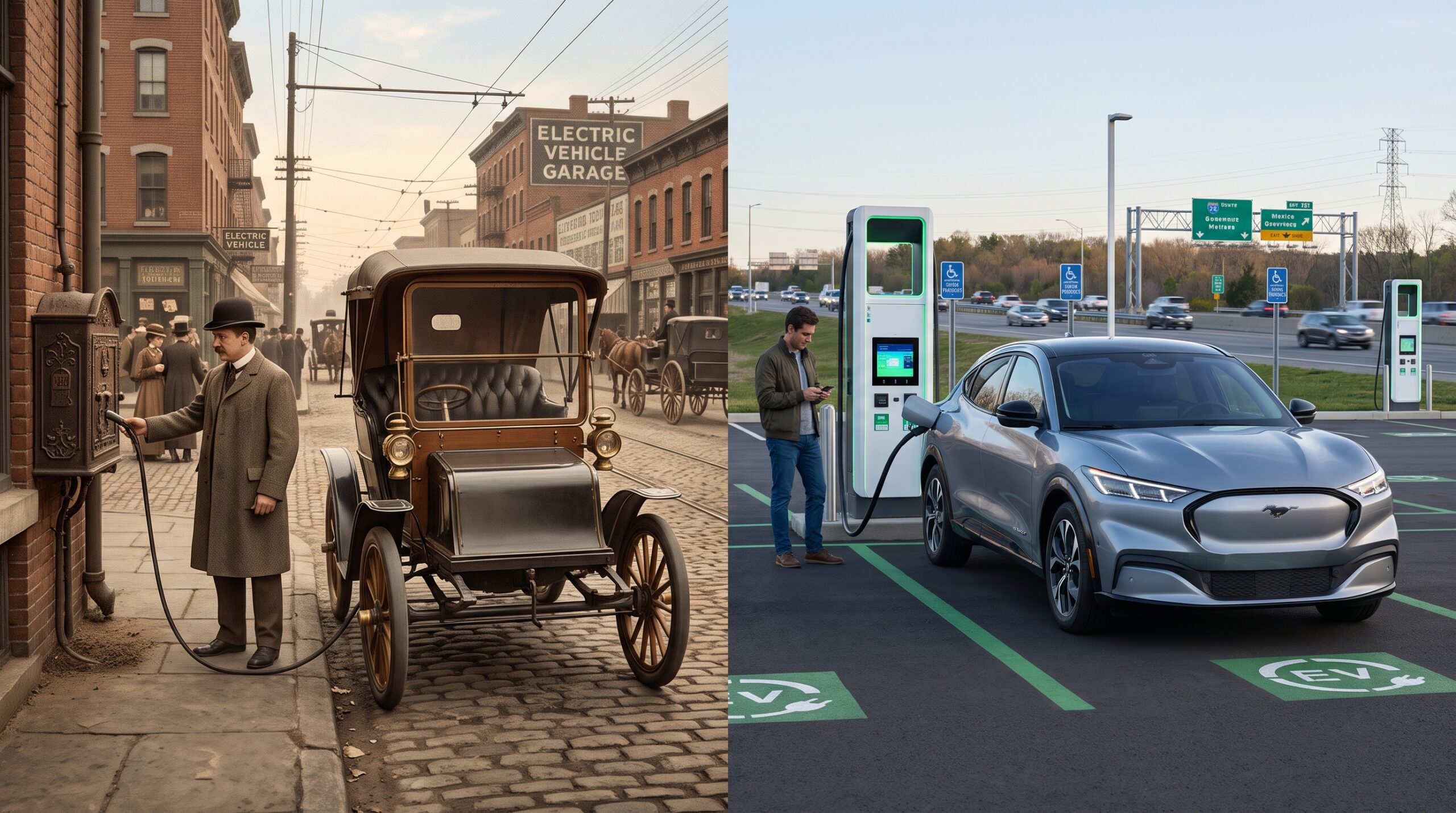
You see electric cars on every highway and charging stations in supermarket parking lots, yet it is easy to forget how long the road to this point actually was. Electric vehicles are not a sudden invention of the last decade. They began as experimental curiosities more than a century ago, nearly disappeared, then returned with better batteries, stronger policy support, and real consumer demand. Understanding that arc helps explain why today’s EVs finally feel practical for everyday drivers.
Early Experiments and the First Electric Boom
In the late 19th and early 20th centuries, electric cars competed directly with steam and gasoline vehicles. Quiet operation, easy starting, and simple controls made them attractive, especially in cities. Early adopters included urban professionals and drivers who preferred not to hand-crank noisy engines. Limited battery range and sparse charging options confined most of these cars to short local trips. When mass-produced gasoline automobiles became cheaper and range anxiety favored liquid fuel, electric cars largely faded from the mainstream market.
Decades of Relative Quiet
For much of the mid-20th century, electric vehicles survived mainly in niche roles—delivery vans, industrial equipment, and experimental prototypes. Oil crises in the 1970s briefly revived interest, and governments plus universities funded research into alternative propulsion. Still, battery technology of the era could not deliver the combination of range, cost, and durability that ordinary buyers demanded. Gasoline infrastructure kept expanding while electric options remained expensive and limited.
The Modern Restart: Technology and Policy Align
The late 1990s and 2000s brought a decisive shift. Advances in lithium-ion batteries, originally driven by consumer electronics, offered higher energy density and longer cycle life. Automakers and startups began producing modern electric and hybrid models. At the same time, air-quality rules, fuel-economy standards, and early purchase incentives in several markets created room for these vehicles to reach customers. The first contemporary mass-market EVs still faced range and charging limitations, yet they proved the concept could work outside laboratories.
Range, Charging, and the Infrastructure Build-Out
Each new generation of batteries improved real-world range. What once felt like a 60- or 80-mile ceiling gradually moved into the 200- and 300-mile territory that matches many drivers’ weekly needs. Public and workplace charging networks expanded, even if unevenly across regions. Fast-charging technology shortened stops on longer trips. Hypothetical illustration: a driver who once rejected electric cars because every journey required careful planning now completes a daily commute and weekend errands with only home charging, using public stations mainly for occasional highway travel. That shift in everyday experience turned EVs from science projects into practical alternatives.
From Early Adopters to Broader Acceptance
Early buyers were often enthusiasts willing to accept trade-offs. As models multiplied, prices became more competitive, and residual values stabilized, a wider audience began considering electric options. Fleet operators, ride-hail drivers, and families looking to reduce fuel costs joined the mix. Traditional automakers poured investment into dedicated platforms rather than simply converting existing gasoline designs. Competition accelerated improvements in software, efficiency, and interior packaging. The conversation moved from “whether” electric cars would matter to “how quickly” they would scale.
Remaining Challenges and the Road Ahead
Adoption is still uneven. Charging reliability, upfront price in some segments, cold-weather performance, and electricity-grid capacity continue to shape buyer decisions. Supply chains for batteries and critical materials remain strategic concerns. At the same time, costs continue to trend downward, new affordable models are appearing, and many regions are tightening rules around combustion engines. The next phase will likely focus less on proving the technology and more on making ownership seamless across different income levels and geographies.
Electric vehicles traveled a long path from early 20th-century city cars to the mainstream options available today. Better batteries, expanding charging networks, regulatory pressure, and sustained engineering effort turned a once-marginal idea into a credible choice for millions of drivers. The evolution is unfinished—range, cost, and infrastructure still improve year by year—but the direction is clear. If you are considering an EV, look at current real-world range, local charging access, and total cost of ownership rather than old assumptions. The technology that once struggled to leave the laboratory now competes on the same roads as every other car.
FAQ
When did electric cars first appear?
Practical electric vehicles were already on the road in the late 19th and early 20th centuries before gasoline cars became dominant.
Why did early electric cars lose out?
Limited range, long recharge times, and the falling cost plus growing fuel infrastructure of gasoline vehicles pushed electrics into the background for decades.
What changed to make modern EVs viable?
Lithium-ion batteries, stronger policy support, dedicated vehicle platforms, and expanding charging networks together closed the practicality gap.
Are electric vehicles now mainstream?
In many markets they have moved from niche to significant and growing share of new sales, though adoption rates still vary widely by region.
What still limits faster adoption?
Upfront cost in some segments, charging access and reliability, cold-weather range, and grid readiness remain important factors for many buyers.
Leave a Reply